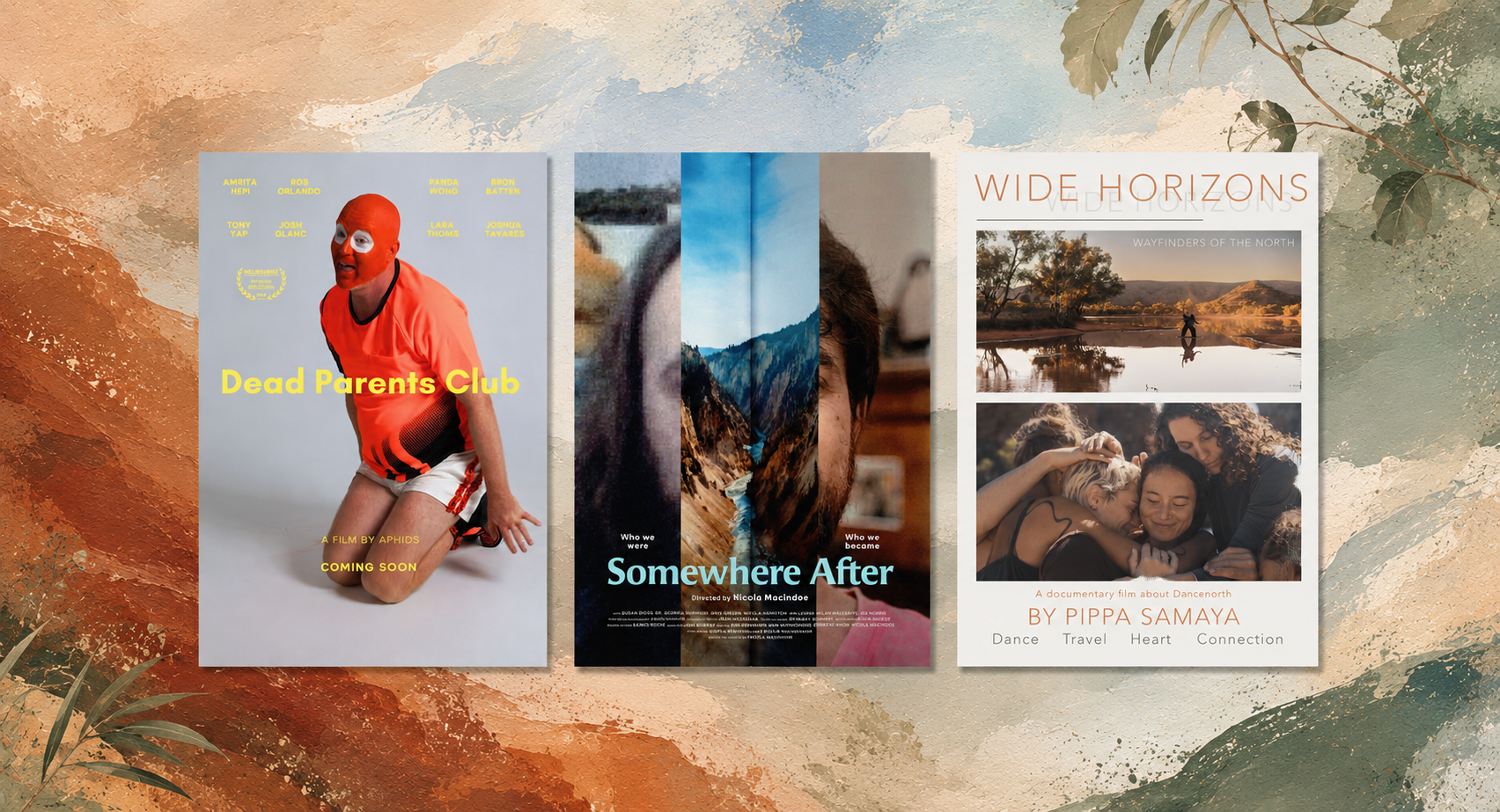
As the Melbourne Documentary Film Festival celebrates another year of nonfiction storytelling, several Australian women directors are slated to screen their first feature documentaries at the festival. Their films span a wide range of subjects and approaches, from reflections on life during and after the COVID-19 pandemic, to the creative energy of a contemporary dance company on tour, to a personal exploration of grief and the cultural stories we tell about parental loss. While each film is distinct, they are united by a curiosity about how people make sense of their experiences and the world around them.
Though varied in subject matter and style, these films share a commitment to understanding people and their experiences. Whether looking back on a period that reshaped everyday life, capturing artists in motion, or examining how grief is reflected through storytelling, each documentary invites audiences to engage with its subjects in a thoughtful and meaningful way.
Their films offer a glimpse of exciting talent within Australia’s documentary community, new voices that are redefining the language of the form, and reminding audiences of the power of documentary cinema to connect us with perspectives beyond our own.
“Somewhere After” directed by Nicola Macindoe
Transporting viewers to a time of global uncertainty, “Somewhere After” directed by Nicola Macindoe explores the impact of Australia’s COVID-19 lockdowns on a group of people during this isolating time and revisits them after the pandemic to see how their lives and perspectives have changed.
Macindoe’s first short documentary “The Art of Doodling” screened at the Melbourne Documentary Film Festival in 2021 while the production of “Somewhere After” was already under way.
“Somewhere After” was originally conceived as a short documentary too, but as Nicola states, “The material from the 2020 interviews was far richer than I ever anticipated, especially as the participants all predicted they wouldn’t have much to say since lockdown had brought their lives to a grinding halt. As I started combing through the transcripts, I realised this was my chance to do what I couldn’t do with “The Art of Doodling” – actually follow those emotional threads wherever they led. I’d interviewed ten people planning to include three to five in a short, but the stories were so compelling I ended up with seven in a feature. Over six years I was able to immerse myself in their lives in a way that changed how I see the world. The reward was discovering how much more there is to people’s stories when you give them time, and when you give yourself time to live your own life and bring those experiences back to the material.”
The thoughtful introspection of the participants offers profound insight into the human experience and audiences are sure to be moved by their openness, while recognizing aspects of their own lives and thoughts during this strange time. It is a glimpse into personal evolution but also how fundamentally connected we remain at our core even when we are physically apart.
If there was going to be a crisis where safety meant distance, how lucky we were to be in the era of Zoom where the desire to see a friend’s face wasn’t an impossibility, but a need met simply in a different way. Where thoughts and ideas could still be explored deeply, dreams and plans imagined and made, and adventures hatched through little glass screens that helped us see towards the future and each other, as we were then and how we hoped to be soon. “Somewhere After” captures this period perfectly and shows us the heart of being human is a wondrous and complex thing.
The generosity of the participants in “Somewhere After” to share their inner lives and speak so candidly about how lockdown affected them is the type of emotional honesty that makes documentary such an important genre. It’s not just a historical record, but enduring evidence of how we persevere and grow.
One of the most compelling aspects of the film is watching the participants listen back to their interviews after the pandemic. It’s not an experience that one is confronted with everyday and you can see how humbling it is as they absorb their words and past thoughts. Their stories offer reassurance that difficult moments do not define an entire life, and there is genuine comfort in witnessing how their perspectives have shifted with time.
The stories of the participants are framed with great sensitivity and care. Nicola explains that “Every visual decision in “Somewhere After” started with a question about what the story needed, not what would look beautiful. The Zoom calls on the surface are not necessarily beautiful and nice to look at, but they feel grounded and real, and we were happy to sit with them as they offer a way into many of the most powerful moments in our story.”
An unforgettable work of documentary filmmaking, “Somewhere After” balances depth and compassion standing as a testament to the power of documentary film to find grace, meaning, and humanity in moments of profound collective change while honoring the intimate human experiences within it.
“Wide Horizons” directed by Pippa Samaya
DIrected by Pippa Samaya, “Wide Horizons” is a phenomenal behind-the-scenes look at one of Australia’s most unique contemporary dance companies, Dancenorth. Vibrant, engaging, and wholly inspiring, the film captures the passion, commitment, and artistry of its dancers as they embark on a tour across Australia.
The film is a visual masterpiece. Given Samaya’s background as a photographer and her award-winning short films, which beautifully capture movement and the heart of her subjects, it’s no surprise that her first feature documentary “Wide Horizons” would be a mesmerizing journey into life as a dancer and a celebration of the body in motion.
The film excels at bringing the audience into the dancers’ physical and emotional worlds, exploring their dedication to the art, not only within the theatre but also in the natural environment that becomes such a vital part of the film’s visual identity.
The cinematography stuns with outdoor sequences showcasing the dancers against expansive natural landscapes that evoke a powerful sense of freedom, connection, and expression. People often talk about how free they feel when dancing, “Wide Horizons” lets the audience experience that feeling, transforming movement into something that is elemental and transcendent. The scenes in nature are inspiring and suggest that the spirit of dance should never be contained to stage alone.
Life is a balancing act, and beyond dance, the world and our lives are always in motion.
The intimate interviews with the dancers throughout the film shine a light on what it’s like to be a parent while on the road and also the realities of unexpected events like injuries that sometimes occur. These scenes are essential and beautiful because they depict real life. It would be easy to depict the life of a professional dancer as glamorous; the performing, the travelling… But that would ignore the juggling, the hard work, the ebbs and flows, the quiet sacrifices, and the raw beauty of life that comes with simply existing as a human. Ever moving, ever changing. This film shows all those things and does so in a way that is authentic and tremendously uplifting.
“Wide Horizons” is essential viewing for all who love the arts, for all who love to dance, and for all who believe in the power of movement to connect us more deeply to each other, the natural world, and ourselves.
“Dead Parents Club” directed by Lara Thoms and Gena Lida Riess
Nobody wants to be part of this club, but membership eventually happens to us all. Grief is a personal and universal experience but few documentaries explore it with the creativity of “Dead Parents Club.” Directed by Lara Thoms and Gena Lida Riess, the film follows a group of individuals who have each lost a parent as they prepare for a stage production centered on some of popular culture’s most famous orphan characters. What begins as a rehearsal process for the production gradually unfolds into something far bigger, an exploration of how stories shape our understanding of loss and how people learn to carry grief throughout their lives.
The premise of the film is immediately intriguing. From fairy tales to animated classics and blockbuster franchises, orphaned protagonists have long occupied a central place in storytelling. They are often depicted as resilient heroes whose loss serves as the catalyst for adventure, growth, or self-discovery. It’s surprising how many characters there are who have experienced the death of a parent: Bambi, Frodo, Belle, Dumbo, Paddington, Batman, and the list goes on. “Dead Parents Club” explores what happens when those fictional narratives collide with real experiences of bereavement. Through rehearsals, discussions, and personal reflections, the participants examine the distance between the stories they grew up with and the realities they have lived.
Despite its subject matter, “Dead Parents Club” is not a sombre viewing experience. The film possesses a warmth and sense of humor that prevent it from becoming overwhelmed by sadness. Moments of laughter emerge naturally from the group dynamic and audiences are reminded that grief and joy are not mutually exclusive. For a feature debut, Thoms and Riess demonstrate a keen understanding of this balance, allowing difficult conversations to coexist on screen with levity and genuine human connection.
The participants are the heart of the film and their vulnerability with each other and, in turn, the audience makes for a truly moving and relatable viewing experience.
Beyond its exploration of grief, “Dead Parents Club” offers a fascinating glimpse into the creative process behind a stage production. Rehearsals, discussions, and moments of collaboration reveal the immense work required to transform lived experiences into art. The film thoughtfully examines the challenges of creating a performance rooted in deeply personal stories, showing how creativity can become a means of reflection, new friendships, and understanding. For anyone interested in theatre or the arts, these behind-the-scenes insights add another rich layer to the documentary.
An incredible and cathartic film, “Dead Parents Club” shows that our enduring fascination with orphan stories may stem from a simple truth that we are constantly searching for ways to understand loss and to feel less alone within it. Love and death bind us all, but when a heart continues to beat through loss, it’s important to remember that it isn’t in a club of one, but joining an infinite number of hearts beating together.
See “Wide Horizons” screening July 14th, “Dead Parents Club” July 17th, and “Somewhere After” July 18th at Cinema Nova as part of the Melbourne Documentary Film Festival.